
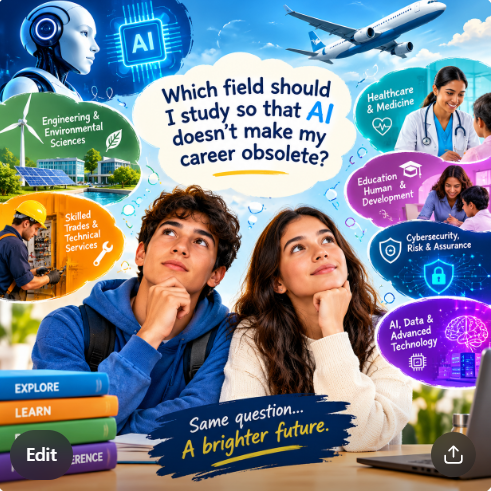
Several young people in my family and friends have asked me this question recently.
My honest answer: there is no such thing as a guaranteed AI-proof profession. But some careers are better positioned to adapt and remain valuable than others.
In my own work as a cyber auditor, I can already see how AI is changing professional responsibilities. For example, an AI tool can draft an audit finding from control-testing evidence in minutes. However, it may overlook a compensating control or misunderstand the wider business context. Someone still needs to challenge the output, validate the evidence and take responsibility for the final assurance opinion.
The way we work will change. Professional judgement and accountability will remain essential.
So, which fields should young people consider?
🔹 Healthcare and allied health: Medicine, nursing, physiotherapy and other clinical professions, where scientific knowledge combines with human care, practical skills and clinical judgement.
🔹 Engineering and environmental sciences: Electrical, mechanical, civil and environmental engineering. Consider specialisms in renewable energy, water and wastewater treatment, pollution control, environmental monitoring, air quality, HVAC systems and smart building controls.
🔹 Skilled technical trades: Electricians, HVAC specialists, robotics technicians and industrial maintenance professionals. The physical world will continue to need people who can install, configure, diagnose and repair complex systems.
🔹 Education and human development: Teaching, mentoring, psychology and specialist learning support, where human interaction, trust and understanding individual needs matter.
🔹 Cybersecurity, risk and assurance: Protecting organisations, managing digital risks and ensuring that increasingly automated systems remain secure, reliable and accountable.
🔹 AI, data and advanced technology: Developing, integrating, securing and governing the technologies that are transforming industries.
But choosing the right field is only part of the equation. Whatever the profession, I believe young people should develop three essential capabilities:
- Strong fundamentals and specialist knowledge in their chosen discipline.
- The ability to use AI effectively as a tool to enhance their capabilities.
- Critical thinking, problem-solving, communication and sound judgement.
The World Economic Forum’s Future of Jobs Report 2025 reinforces this direction, identifying AI and big data, cybersecurity and technological literacy among the fastest-growing skills, while analytical thinking remains a critical skill for employers.
My advice to students and parents is simple: look for the intersection of three things:
What are you good at? What genuinely interests you? And where will people continue to need specialist knowledge, practical skills and sound judgement?
Don’t choose medicine simply because you think AI cannot replace doctors. Don’t choose computer science simply because AI is booming. And don’t overlook engineering or skilled trades because they don’t necessarily follow the traditional university route.
The objective isn’t to find a career that AI can never touch. It’s to become a professional who knows how to work with AI, adapt to change and continue adding value.
Parents, educators and employers: what fields would you encourage today’s students to explore, and why?
#FutureOfWork #CareerAdvice #ArtificialIntelligence #FutureSkills #Education
Disclaimer: The author is a cybersecurity professional and researcher with an interest in information technology, cybersecurity, AI Governance, and emerging technologies. The views expressed are solely the author’s own and do not represent or constitute the views of any employer, affiliated organisation, or institution. This article is written in a personal capacity for informational and discussion purposes only.
AI tools were used to assist with research, source verification, and drafting of this article. The analysis, opinions, and conclusions are my own.