
Your organisation is probably paying for AI that most employees use to write emails – and what to do before your CFO notices.
We’ve been here before.
Cast your mind back to the mid-2010s. Every CIO was under pressure to “move to the cloud.” It was the future. On-premise infrastructure was legacy thinking. So organisations migrated — everything, often indiscriminately. Payroll systems, legacy databases, bespoke line-of-business applications that had no business being in the cloud. Then the AWS and Azure bills arrived. Finance teams blinked. Suddenly “cloud-first” became “cloud-where-it-makes-sense,” and an entire industry of FinOps consultants was born to help organisations claw back what they’d overspent.
Artificial intelligence is following the same script — almost beat for beat. And most organisations haven’t noticed yet.
If that makes you uncomfortable, it should. Because this time, the bills are arriving faster.
The AI Gold Rush Inside Your Office
The numbers are remarkable. According to CB Insights, GitHub Copilot alone generated an estimated $600 million in revenue in 2024. Microsoft’s broader Copilot suite brought in an estimated $800 million. Organisations are deploying AI assistants to entire workforces at speed, driven by competitive pressure and the genuine fear of being left behind.
But here’s the question nobody is asking loudly enough: what are employees actually doing with these tools?
Think about your own organisation for a moment. Picture the full range of people who have been given an AI licence — from the data scientists and software engineers to the office manager, the HR coordinator, the finance administrator processing invoices. Now ask honestly: what is that last group doing with their AI subscription every day?
The honest answer, for the majority of users in most organisations, is this: writing emails. Checking grammar. Summarising a document. Rephrasing a paragraph. These are genuinely useful tasks — but they are not tasks that require a state-of-the-art frontier AI model running on expensive cloud infrastructure, billed per token, per prompt, per interaction.
This is the quiet inefficiency at the heart of most enterprise AI rollouts. And it is costing organisations serious money.
The Price Tags Nobody Warned You About
Take Microsoft Copilot, arguably the most widely deployed enterprise AI assistant right now. The headline figure sounds manageable: $21 per user per month (reduced from $30 in late 2025). Reasonable, you might think.
Until you read the small print.
That $21 is only the add-on. Stack it on top of the required Microsoft 365 Enterprise base licence and the true all-in cost lands between $66 and $87 per user per month depending on your tier. For a 1,000-person organisation, that’s potentially over £800,000 per year — before you account for the training, change management, and SharePoint permissions audits that a proper deployment actually requires.
The model is also shifting in ways that could dramatically increase costs further. Microsoft began rolling out usage-based pricing in April 2026: a base platform fee covers foundational features, but advanced AI operations — the complex reasoning tasks — are billed per query at $0.03 per prompt. This sounds granular until you multiply it across thousands of employees with no usage awareness and no guardrails.
Copilot Studio, Microsoft’s agent-building platform, takes the complexity further still. It operates on a credit system where one credit buys a scripted FAQ answer, but a single reasoning-model response costs 100 credits. The same agent can run $8 per month — or $800 — depending entirely on how it is built. Most IT departments discovering this for the first time do a double-take.
Sound familiar? It should. It is the same story as cloud egress fees, reserved instance pricing, and data transfer costs — the charges that nobody fully understood until the invoice landed.
When the Bill Arrives: Real Stories of AI Shock
If you think this is theoretical, consider what is already happening out there.
OpenAI CEO Sam Altman publicly acknowledged in 2026 that token costs had become a “massive problem” for corporate clients, with many companies burning through their entire annual AI budget in a single quarter. Uber — not a small organisation unfamiliar with technology costs — exhausted its yearly AI allocation in just four months and was forced to impose emergency usage caps on employees.
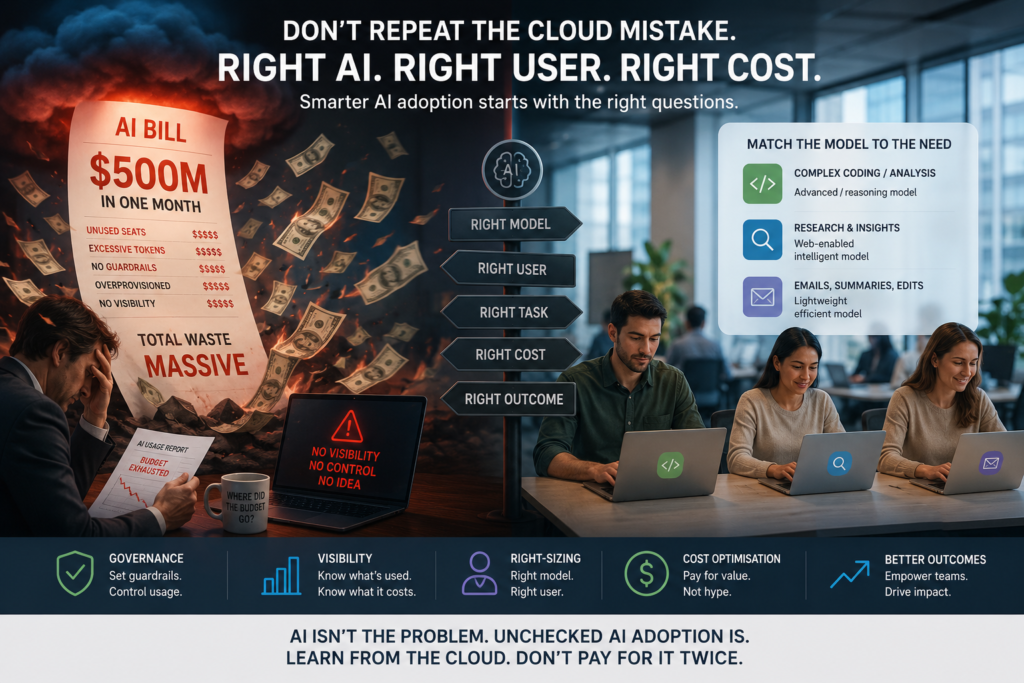
But the story that stopped conversations in IT leadership circles happened in May 2026. An unnamed US enterprise was reportedly billed approximately $500 million in a single month for AI usage — according to reports cited by Axios. Not a typo. Half a billion dollars. In one month. Because employees had been given access with no governance, no usage caps, and no awareness of what each interaction was costing.
This is not a crisis of AI being too expensive in principle. It is a crisis of deployment models that treat frontier AI like a flat-rate utility, when it is anything but.
And here is the data point that should make every IT procurement team pause: industry analysis suggests 35% of AI seats across enterprises currently sit idle. More than a third. Organisations are paying for access that most of their workforce barely touches — and when employees do use it, a large proportion are doing tasks that did not require the most powerful models available.
At what point does your organisation have a similar conversation with finance?
Does Everyone Need the Best Model?
Here is the core issue, and it is the same one that tripped up cloud adoption a decade ago: the assumption that one solution fits all users, all tasks, all departments.
A developer using AI to generate and debug complex code has genuinely different requirements than a marketing coordinator asking it to tighten up a client email. A research analyst pulling real-time web data and synthesising competitive intelligence is in a completely different category from a finance administrator using AI to summarise a meeting transcript.
Yet most enterprise AI deployments today hand the same premium, frontier-model subscription to every single employee — regardless of what they actually need it for.
In the cloud world, we eventually learned to right-size workloads. Batch processing runs on reserved instances. Static websites go on cheap object storage. Only the genuinely demanding applications get premium compute. Nobody would provision a high-performance compute cluster to host a static company brochure website. Yet that is essentially what organisations are doing when they give a frontier AI subscription to someone whose main use case is rephrasing emails.
A Smarter Model: Match the Tool to the Task
The solution is not to rip out AI tools and retreat. It is to deploy them with the same discipline that eventually made cloud computing cost-effective — matching the tool to the task, not handing the most expensive option to everyone by default.
The majority of workers — those drafting emails, summarising reports, handling routine communications — can be served effectively by a self-hosted open-source model running on the organisation’s own infrastructure. Tools like Ollama have made this significantly more accessible, and models such as Meta’s Llama 4 and Mistral now achieve roughly 80% of the capability of proprietary models, at 86% lower cost. Keeping data on-premise also addresses the data privacy concerns that GDPR-conscious organisations should already be weighing.
Knowledge workers doing more complex drafting or internal research sit comfortably on a mid-tier subscription. And the genuinely demanding users — developers, analysts, researchers who need real-time web access and multi-step reasoning — represent, by most industry estimates, around 2% of the workforce. Those are the people who have earned the premium licence.
This is not theoretical. Microsoft itself has begun acknowledging the economics — their new usage-based pricing model emerged partly because large enterprises were pushing back on paying flat fees for uneven utilisation. A multinational retailer saw its monthly Copilot bill drop by 22% simply by switching pricing models. Imagine applying that discipline proactively, before the bill shock forces your hand.
Open-Source Is Not a Free Lunch
At this point you might be thinking: great, we’ll just self-host everything and cut costs dramatically. Not so fast.
The costs shift rather than disappear. Running a local model requires GPU hardware, internal expertise to manage deployment and updates, and ongoing evaluation as the open-source landscape evolves rapidly. The economics generally work in your favour when you have sufficient volume of basic-task users to justify the fixed infrastructure cost, when data privacy requirements already push you toward on-premise processing, and when your IT team has — or can develop — the capability to manage it sustainably.
The point is not that open-source is always the answer. The point is that it deserves a serious seat at the table in your AI strategy conversations — and right now, for most organisations, it is not even in the room.
The Governance Gap
Here is a truth that the cloud era taught us painfully: technical right-sizing alone is not enough.
What ultimately controlled cloud costs was governance — tagging resources, setting departmental budgets, building internal chargeback models, monitoring usage dashboards, and holding teams accountable for what they consumed. The organisations that got cloud economics right were not necessarily the most technically sophisticated. They were the ones that treated it like financial infrastructure, not a utility with unlimited headroom.
AI needs exactly the same treatment, and most organisations are starting from zero. With GitHub Copilot moving to token-based billing in June 2026 — causing what developers are already calling “10 to 50 times bill shock” — the pressure is building fast. The organisations that manage this well will audit usage before the invoices force them to, set hard budget caps by department, and review seat allocations quarterly — not because it is bureaucratic, but because that discipline is what separates organisations that extract real value from AI from those that simply accumulate impressive-sounding costs.
We Have Been Here Before — and That Is the Point
If you work in IT or technology leadership and you have read this far, you already know where this is going — because you have lived some version of it before.
Every phase of the cloud journey is now repeating: the initial excitement, the indiscriminate rollout, the bill shock, the scramble to rationalise, and eventually the mature hybrid model where workloads sit where they make economic and technical sense. The organisations that fared best in cloud were not the ones that moved fastest. They were the ones that paused long enough to ask which workloads actually belonged there.
We have been given something rare: a second chance to get this right, with the benefit of hindsight. The cloud playbook exists. The mistakes are documented. The rationalisation frameworks are already built. We do not have to repeat the same expensive journey of discovery.
The AI tab is already running. The only question is whether anyone is watching it.
Sources
- Microsoft Copilot Pricing: What It Really Costs in 2026 — GoSearch Blog
- Microsoft Copilot Usage-Based Pricing, April 2026 — Windows News
- Copilot Studio Credit Pricing — CloudZero
- AI Bill Shock / “Tokenpocalypse” — BigGo Finance
- $500M Claude Billing Incident — Axios, reported May 2026
- 35% of AI Seats Idle / Tiered Licensing — CIT Solutions
- Open-Source LLM Cost Savings — Swfte AI
- GitHub Copilot Token Billing Shock — FindSkill.ai
- Enterprise AI Market Size — CB Insights
- Running LLMs Locally with Ollama — daily.dev
Disclaimer: The views and opinions expressed in this article are the author’s own and do not represent, reflect, or constitute the views of any organisation the author is affiliated with, employed by, or associated with. This content is written in a personal capacity for informational and discussion purposes only. Nothing in this article should be construed as official policy, strategic guidance, or endorsement by any employer or institution. All references to third-party research, pricing, and reported incidents are drawn from publicly available sources and are cited accordingly.